


















































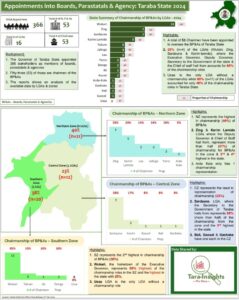
In the distribution of 366 total appointments, 53 are chairmanship positions while 313 are members. Two recently analyzed infographics on appointments to Boards, Parastatals, and Agencies (BP&As) in Taraba State, have raised critical concerns about fairness and equitable representation. These visuals highlight significant disparities in the distribution of 366 total appointments and 53 chairmanship positions across the state’s 16 Local Government Areas (LGAs).
Key insights from the analysis include:
1. Concentration of Power in Select LGAs: Four LGAs—Wukari, Zing, Sardauna, and Karim Lamido—dominate 60% of the chairmanship positions. This is disproportionate considering these LGAs account for only 25% of the state. The Northern Zone, holds the highest number of chairmanships (40%), followed by the Southern Zone (38%) and the Central Zone (22%).
2. Neglected Areas: Ussa LGA is glaringly absent from the list of chairmanship roles, while other LGAs, such as Bali, Gashaka, and Gassol, have minimal representation. This imbalance raises concerns about inclusivity and equal opportunity for all LGAs.
3. Zone-Wide Disparities: The Northern Zone claims 31% of the general BP&A appointments, with Zing alone contributing 27%. Similarly, the Southern Zone leads with 33%, while the Central Zone accounts for 31%. Despite these near-equal distributions in general appointments, the disparity in chairmanship roles highlights a skewed power structure.
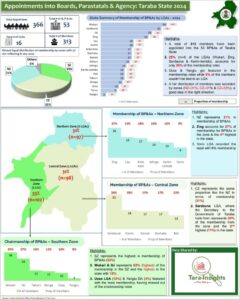
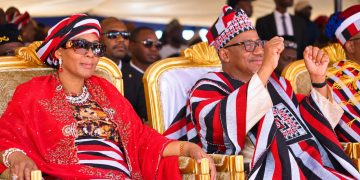
4. Highlighting Nepotism: Wukari L.G.A, home to the Executive Governor, represents 65% of chairmanship roles within the Southern Zone, while the Secretary to the Government of the State’s LGA (Sardauna) dominates the Central Zone’s chairmanship at 58%. Zing L.G.A, home to the Deputy Governor and the Speaker of the State House of Assembly accounts for 33% of the Chairmanship appointments from Northern Zone. This suggests a trend of favoring LGAs closely linked to influential political figures.
These findings underscore a potential systemic bias in Taraba State’s appointment process. While merit-based appointments are vital for good governance, the current pattern calls for greater transparency, fairness, and accountability. It is imperative for the Taraba State Government to address these imbalances to ensure that all LGAs have equal opportunities to contribute to and benefit from governance structures.
The inclusion of underrepresented areas in leadership roles will not only enhance equity but also foster unity and inclusivity in the state’s administration.