



























































By Haruna Mohammed Salisu
There is a moment, familiar to every immigrant who has ever walked into a room where no one looks like them, when the air seems to thicken. You feel your foreignness before anyone speaks it. You hear yourself introduced — the accent, the surname, the country — and something in the room shifts. Not hostility, necessarily. Something quieter. A recalibration. A waiting. As if the room is asking, without words: prove you belong here.
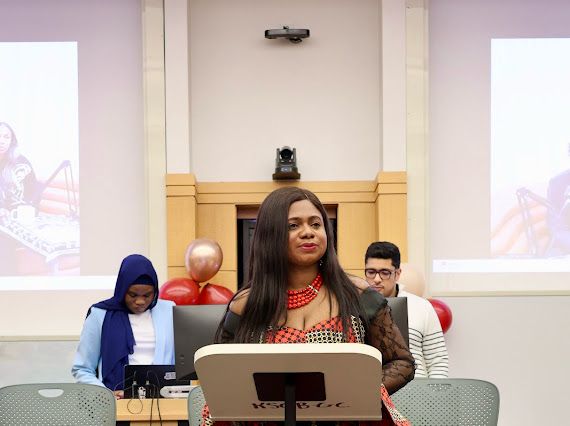
Chigozie Regina Nwangele knows that moment. She has lived inside it. And in February 2026, barely a year after arriving in the United States from FCT Abuja, Nigeria, she walked out the other side of it holding the Kelley Coin of leadership — the highest honor bestowed by Indiana University’s Kelley School of Business. She is the first Nigerian. The first African. The first person from the continent to receive the Kelley Coin of leadership. That fact alone should give us pause.
The Kelley Coin of leadership is not a grade-point trophy. It is not awarded for test scores, class rank, or the accumulation of credentials that universities so often mistake for character. It is peer-nominated and committee-reviewed. A distinction conferred on those who demonstrate exceptional leadership, service, integrity, collaboration, and sustained positive impact within the institution’s global community. It is, in other words, a measure of who you are when no one is grading you. A measure of what you build when no syllabus requires it.
The Kelley School of Business is not a small stage. Consistently ranked among the finest business schools in the United States, it draws ambitious minds from six continents and dozens of countries. Its alumni occupy boardrooms, shape policy, and lead institutions. To be recognized within that ecosystem — not for what you know, but for how you lead — is no small thing. To be recognized within a single year of arrival is something else entirely.

But this essay is not about the coin. Coins are symbols, and symbols only matter if we interrogate what they represent. The deeper question is this: what does it mean when a young Nigerian woman, operating in a system she did not design and a culture she did not grow up in, earns the highest peer-nominated honor that system has to offer? And what does it say — about Nigeria, about the diaspora, about the quiet architecture of excellence — that she did it in twelve months?
To answer that, you have to look past the ceremony. You have to look at the work. When Nwangele arrived at Kelley, she did not arrive empty-handed. She carried with her a formation shaped by the particular pressures of Nigerian life — the resourcefulness demanded by scarcity, the social intelligence required to navigate complex communal hierarchies, the stubbornness that comes from being told, in a hundred indirect ways, that the world was not built with you in mind. These are not soft qualities. They are survival competencies. And in the right environment, they become leadership competencies.
She was nominated by her peers to serve as president of the African Business Club. The word “nominated” deserves emphasis. She did not campaign. She did not lobby. Her colleagues — many of them her seniors — looked at her conduct, her energy, her evident commitment, and decided, collectively, that she was the person to lead. This is the kind of authority that cannot be manufactured. It is earned in hallways and study sessions, in the small moments when no one is watching, when the only audience is the work itself. What she did with that authority is instructive.
Nwangele and a small team of colleagues drafted a business proposal and secured a ten-thousand-dollar grant — no small feat for a first-year student navigating an unfamiliar institutional landscape. With those funds, they conceived and executed the African Business Week, a weeklong celebration of African enterprise, culture, and intellectual ambition. It was, by all accounts, the first event of its kind in the history of the Kelley School.
The week included a business challenge that drew over three hundred applications from entrepreneurs across the African continent, with Nigeria producing the highest number of applicants. Three winners were selected and awarded from the grant funding. There was a conference — the largest the school had hosted — organized with the kind of seamless precision that belies the chaos behind it. And there was a closing celebration, an evening of African music, food, dance, and fashion that people at Kelley still talk about months later.
Read that paragraph again. A first-year student, in a country she had lived in for less than a year, organized a continent-spanning business competition, a record-setting conference, and a cultural event that became institutional memory — while maintaining her coursework, while recruiting, and fulfilling her role as a Globase-Leader nominated by the school for a consulting engagement in Argentina. Also leading the Tech Club as a VP. The sheer logistical weight of it is staggering. But logistics is the easy part to admire. What is harder to see, and more important, is the vision behind it.
Nwangele was not building a résumé line. She was building a narrative. She understood, with the instinct of someone who has spent a lifetime watching Africa be flattened into a single story, that the most powerful thing she could do at Kelley was to create a space where the complexity and brilliance of the continent could be experienced, not explained. Where African entrepreneurs could compete on merit. Where African culture could be celebrated without the condescension of exoticism. Where her classmates could encounter Africa not as a charity case but as a peer.
That is not event planning. That is cultural diplomacy. And she executed it with the discipline of someone who understood that failure would not be hers alone — that when you are the first, your stumbles become the continent’s stumbles, and your triumphs, if you are lucky, open a door that others might walk through.
We do not talk enough about the cost of this kind of excellence. The late nights are obvious. The academic strain is predictable. But there is another cost, subtler and more corrosive: the psychic toll of perpetual translation. Of being the person who must constantly interpret yourself — your accent, your references, your ways of thinking — for an audience that has no framework for you. Of carrying the unspoken weight of representation, knowing that your performance will be read not as individual but as categorical. She succeeded, and so her success becomes evidence that Africans can succeed. Had she stumbled, the reading would have been equally categorical, and far less generous.
Nwangele does not speak about this burden with self-pity. In her own account of the experience, what comes through is not complaint but a kind of fierce clarity. She knew the obstacles. She accepted them as the terrain. And she moved.
There is a temptation, when writing about African achievement in Western institutions, to frame it as a story of arrival — as if the excellence began at the airport. This framing is lazy, and it is wrong. What Nwangele demonstrated at Kelley was not formed at Kelley. The leadership instincts, the communal ethic, the ability to mobilize people across difference, the discipline required to execute at scale under pressure — these were shaped in Nigeria. By its schools, its communities, its particular crucible of constraint and aspiration. What America provided was a stage. What Nigeria provided was the performer.
This distinction matters because the conversation about the African diaspora too often centers on what the West gives to African migrants — opportunity, resources, platforms — and too rarely on what African migrants give to the West. Nwangele did not merely benefit from Kelley. She enriched it. She expanded what the institution understood about leadership, about community, about what a business school could be. The Kelley Coin, in honoring her, was also honoring what she had made visible: that excellence is not a Western patent, and that the values the coin represents — integrity, service, collaboration, impact — are not values that any one culture can claim.
We live in a moment saturated with leadership language. Every conference keynote, every corporate retreat, every LinkedIn post invokes it. But true leadership — the kind that earns peer recognition rather than self-promotion — remains rare. It is quiet. It is costly. It shows up not in grand declarations but in the willingness to do the unrewarded work: the over hundred emails to the over thirty potential speakers, the late-night revision of a grant proposal, the difficult conversation with a teammate who has lost momentum. Nwangele’s leadership was of this variety. It was not performed. It was practiced.
Somewhere in Ebonyi State, a young woman is sitting in a classroom, or walking a red-earth road, or staring at a phone screen, wondering what is possible. She carries the same formation that Chigozie Regina Nwangele carried — the same discipline, the same communal intelligence, the same stubborn refusal to accept someone else’s ceiling as her own. She may not yet know about the Kelley Coin. She may never have heard of Indiana University. But the door that Nwangele has opened is not a door to a particular institution. It is a door to a particular idea: that service, pursued with integrity and discipline, will find its recognition — not because the world is fair, but because excellence, when it is genuine, is very difficult to ignore. The coin is small. What it represents is not. And what it signals — about Nigeria, about Africa, about the architecture of character built in places the world too often overlooks — is a story the world needs now more than it knows. Fly further, Regina. Fly better!
Haruna writes from Indiana University, USA.