

















































By Dr. Babatunde Raji
Nigerian Economist | Fellow, Chatham House Research Institute, London | Fellow, Harvard Business School
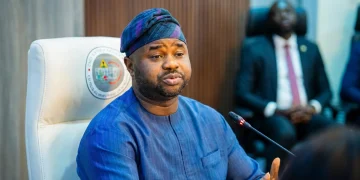
As an economist and policy analyst focused on sustainable development in emerging markets, I am particularly fascinated by subnational leaders who understand the economic dividends of investing in human capital. Governor Seyi Makinde of Oyo State is one such leader. His approach to healthcare reform is not just socially responsible. It is economically strategic.
In Oyo State under Makinde, health is no longer seen as a burden on the budget, but as an investment in productivity, poverty alleviation, and long-term GDP growth. From the outset of his administration, Governor Makinde prioritized the revitalization of primary healthcare, a decision that reflects a deep understanding of economic fundamentals. Healthy populations mean a more robust labour force, lower out-of-pocket spending for households, and better educational outcomes. These are the core building blocks of a competitive state economy.
Makinde’s administration rehabilitated over 200 Primary Healthcare Centres (PHCs) across all 351 wards, bringing quality care closer to rural communities. This decentralization of healthcare not only reduces travel costs for the poor, but also significantly lowers mortality rates. From a cost-benefit analysis, this is one of the most efficient uses of public funds.
In addition, the launch of the Oyo State Health Insurance Scheme (OYSHIA), which now covers tens of thousands of informal sector workers, demonstrates an understanding of how health security supports economic inclusion. Many micro-entrepreneurs, artisans, and market women who previously saw illness as a one-way ticket to financial ruin now have a safety net that allows them to continue contributing to the local economy.
Governor Makinde has also modernized the Adeoyo Maternity Hospital and the Ring Road State Hospital, increasing access to maternal and child healthcare. Two areas where Nigeria has historically struggled. These investments are reducing preventable deaths and enhancing long-term human capital formation, which is directly correlated to GDP growth.
His administration’s responsiveness during the COVID-19 pandemic further underscored his leadership depth. Makinde swiftly mobilized isolation centers, engaged in contact tracing, and created a data-driven dashboard for public information, earning Oyo State accolades nationally and abroad for its transparent and science-led response.
What sets Governor Makinde apart is that he doesn’t see health merely through the lens of philanthropy or social welfare, but as an economic imperative. In doing so, he’s setting a standard for how subnational governments can transform healthcare into a growth engine.
In my professional opinion, Oyo State under Governor Makinde offers a replicable model for other states across Nigeria, and indeed, for many African economies struggling with the health-development nexus. His leadership exemplifies how transformational governance in health can serve as a catalyst for inclusive economic progress.