



























































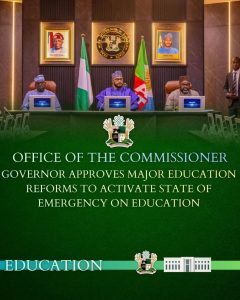
The Zamfara State Government, under the leadership of His Excellency, Governor Dauda Lawal, has approved a series of far-reaching policy measures and strategic interventions aimed at fully operationalizing the State of Emergency on Education declared in 2023.
This landmark approval follows the submission of comprehensive memoranda by the Honourable Commissioner for Education, Science and Technology, Hon. Abdulmalik Abubakar Gajam, outlining urgent reforms required to reposition the education sector for efficiency, equity, and sustainable development.
Key Approvals
1. Constitution of State Steering Committee on Education Emergency
Council has approved the establishment of a high-level, multi-sectoral Steering Committee to drive the implementation of the State of Emergency on Education.
The Committee, chaired by the Honourable Commissioner for Education, brings together key Ministries, Departments, and Agencies, including Finance, Budget and Economic Planning, Local Government, Justice, and all critical education parastatals.
The Committee is mandated to operate under clearly defined Terms of Reference structured around five thematic pillars:
School Security, Access, and Student Welfare
Infrastructure and Institutional Development
Teacher Capacity and Welfare
Governance and Data Management
Curriculum, Equity, and Specialized Education
This approval provides, for the first time, a unified governance structure to translate the 2023 declaration into measurable and time-bound outcomes.
2. Approval of 120-Day Rapid Intervention Action Plan
Council also approved a 120-Day Rapid Intervention Action Plan designed as a stabilization and reset framework for the education sector.
The plan targets critical areas including:
Out-of-school children reduction
Payroll cleansing and staff rationalization
Rehabilitation of 20 model schools
Teacher training and capacity development
Digital education systems and data management
School feeding and student welfare programs
This intervention aligns with global best practices and is expected to deliver immediate, visible improvements while laying the foundation for long-term reforms.
3. Urgent Measures on School Security and Learning Environment
In response to alarming findings from field assessments, Council approved:
The constitution of a Joint Committee to identify and remove illegal structures around schools across the State
Immediate actions to secure school environments and protect students from criminal and social risks
A ban on indiscriminate auctioning of school assets pending the development of a transparent asset management framework
These measures are aimed at restoring safety, dignity, and order within school environments.
4. Establishment of WAEC CBT Center
Council approved the allocation of land for the construction of a modern Computer-Based Testing (CBT) Center in partnership with the West African Examinations Council (WAEC).
This intervention ensures that Zamfara State students are fully prepared for the transition to digital examinations and are not disadvantaged in national assessments.
5. Education Workforce Reform
Council approved the transfer of non-teaching staff from the Ministry’s payroll to appropriate Ministries, Departments, Agencies, or private service providers.
This reform will:
Improve payroll efficiency and transparency
Refocus education spending on teaching and learning
Maintain job security while enhancing administrative efficiency
6. Adoption of Domesticated TRCN Career Path Policy
Council endorsed the Domesticated Teachers Registration Council of Nigeria (TRCN) Career Path Policy, establishing a competency-based framework for teacher progression.
The policy introduces:
A four-tier career structure (Beginner, Proficient, Mentor, Distinguished)
Mandatory teacher licensing and Continuous Professional Development (CPD)
Performance-based incentives and welfare packages
An Implementation Committee has also been approved to oversee the rollout of this policy across the State.
7. Approval to Develop a Unified Education Sector Law
Council granted approval for the development of a Single, Unified Education Sector Law covering Early Childhood to Tertiary Education.
The proposed law will:
Harmonize mandates across all education agencies
Eliminate duplication and inefficiencies
Strengthen governance and accountability
Enable faster and more coordinated emergency response actions
A New Direction for Education in Zamfara
Speaking on the approvals, the Honourable Commissioner for Education, Science and Technology, Hon. Abdulmalik Abubakar Gajam, described the decisions as a turning point in the history of education in Zamfara State.
“These approvals mark the transition from policy declaration to full-scale implementation. We now have the governance structure, the operational framework, and the political will to rescue, rebuild, and reposition education in our State,” he stated.
He further emphasized that the next phase will focus on rapid execution, transparency, and measurable impact across all levels of education.
Conclusion
The Zamfara State Government reiterates its unwavering commitment to delivering inclusive, safe, and quality education for all citizens. These approvals collectively represent a bold and decisive step toward restoring public confidence and securing the future of over half a million learners across the State.
Signed:
Hon. Abdulmalik Abubakar Gajam
Commissioner of Budget and Planning &
AG.Commissioner of Education, Science and Technology