


























































Governor targets skills-driven education, promises to take College of Innovation, Science and Entrepreneurship beyond initial accreditation.

Governor Ahmadu Umaru Fintiri has reaffirmed his administration’s commitment to transforming education in Adamawa State from a predominantly certificate-driven system into one anchored on practical skills, innovation, entrepreneurship and economic self-reliance.
The Governor spoke when a delegation of the National Board for Technical Education (NBTE), led by Garba Danasabe, paid a working visit to him as part of the Board’s assessment of the state’s College of Innovation, Science and Entrepreneurship.
The visit marks an important stage in the process of assessing the institution and verifying the information and documentation submitted by the state ahead of accreditation.

Danasabe, who conveyed a goodwill message from the NBTE, said the team had been constituted to undertake a comprehensive verification exercise, assess the institution against prescribed standards and make recommendations in areas where improvements or adjustments may be required.
He explained that the exercise was intended to ensure that the institution meets the regulatory requirements necessary for accreditation and sustainable operation.
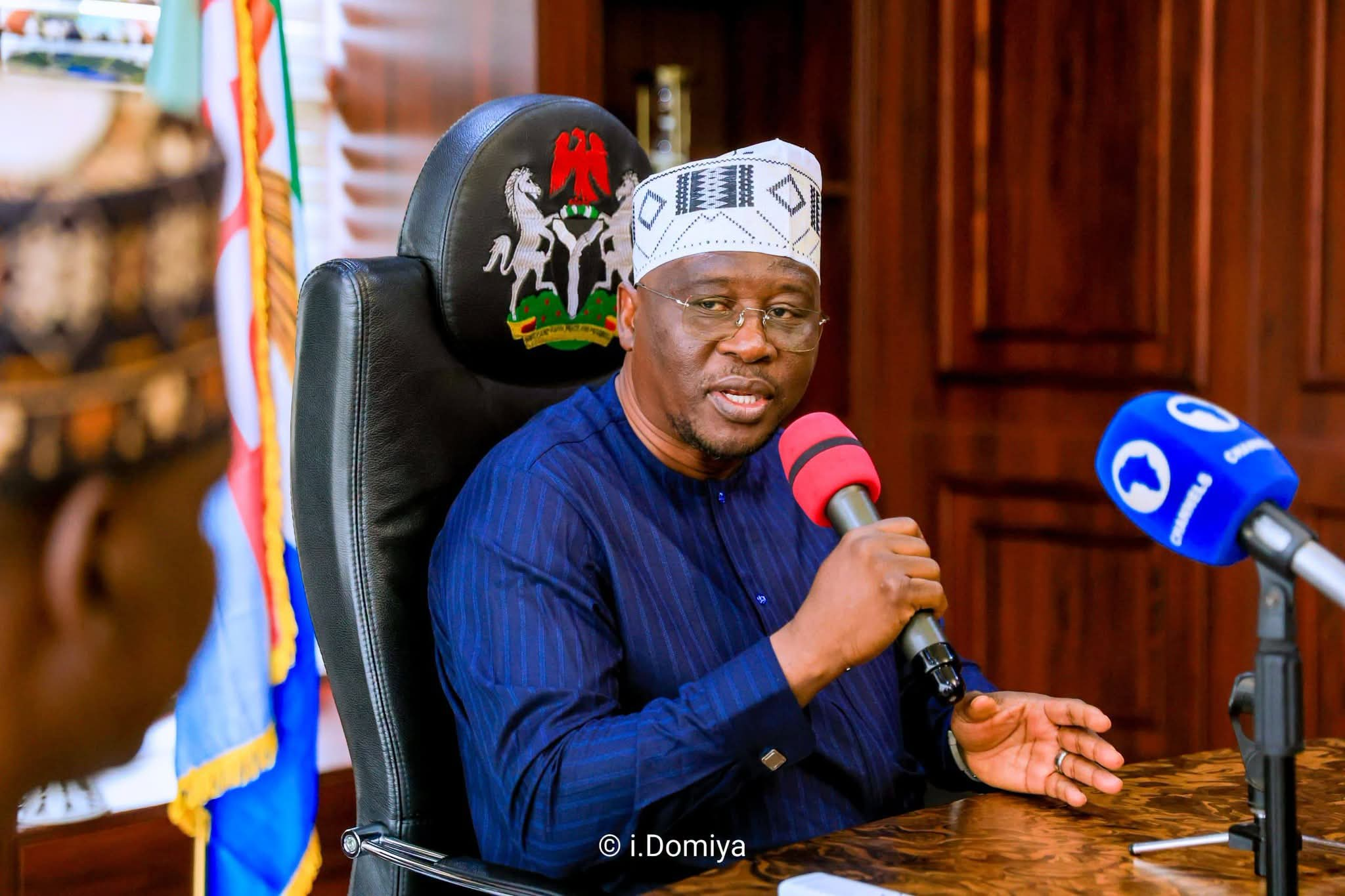
Receiving the delegation, Governor Fintiri welcomed the assessment, describing it as an opportunity for the state to objectively measure the institution against established national standards.
He assured the NBTE that the state government would provide the necessary cooperation and support throughout the process, stressing that Adamawa was prepared to make whatever amendments might be required to bring the institution fully in line with regulatory standards.

But the Governor made it clear that his administration’s ambition goes far beyond simply securing accreditation.
Fintiri said the state was determined to build the institution into a full-fledged College of Innovation, Science and Entrepreneurship capable of producing graduates who possess not just certificates, but practical skills that can make them economically productive.
His message was unequivocal: no student should pass through Adamawa’s educational system and graduate without acquiring a skill that can provide a means of livelihood.
That position captures one of the most consequential elements of the administration’s evolving education philosophy—placing employability, enterprise and practical competence alongside conventional academic qualifications.
The Governor said Adamawa would not stop at the accreditation of the initial seven programmes, expressing his determination to progressively expand the institution and meet the requirements for additional programmes and full institutional development.
FROM CERTIFICATES TO CAPACITY
For Adamawa, the importance of the institution lies in what it could become.
The state has a predominantly youthful population, and the challenge confronting the education sector is no longer simply how to get more young people into classrooms, but how to ensure that what they learn equips them to survive and thrive in a rapidly changing economy.
A properly accredited College of Innovation, Science and Entrepreneurship could provide an important bridge between education and the world of work.

It has the potential to train young people in technical and vocational disciplines, develop entrepreneurial capacity, encourage innovation and create pathways into emerging areas of the economy.
Such an institution could also help change the mindset of young people from one centred almost exclusively on searching for white-collar employment to one that embraces enterprise, innovation and job creation.
AN INSTITUTION FOR THE FUTURE
The significance of the college is therefore not limited to its physical infrastructure or the number of programmes it offers.
Its real value will ultimately be measured by the quality of graduates it produces and the economic opportunities those graduates are able to create.
If successfully developed, the institution could become a critical component of Adamawa’s human-capital strategy—producing technicians, innovators, entrepreneurs and skilled professionals capable of contributing directly to the state’s economic development.
For a state seeking to diversify its economy and reduce dependence on traditional sources of employment, this represents a strategic investment in the future.
The NBTE assessment consequently comes at a critical moment.
It provides an opportunity for the state to subject its ambition to professional scrutiny, correct deficiencies where necessary and build an institution that can compete credibly within Nigeria’s technical education system.
Governor Fintiri’s assurance that the government is ready to comply with all regulatory requirements, while simultaneously seeking to go beyond the initial seven programmes, suggests that the administration sees the project not as another government institution, but as a long-term investment in the productive capacity of Adamawa’s young population.
The larger vision is clear: an Adamawa where education does not end with a certificate, but produces skills, ideas, enterprises and opportunities.
And if that vision is matched with sustained investment and strong institutional management, the College of Innovation, Science and Entrepreneurship could ultimately emerge as one of the defining human-capital investments of the Fintiri administration