

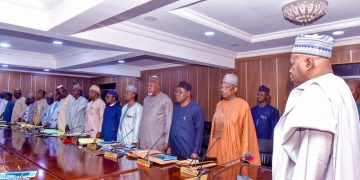



































The attention of the entire nation is on Edo, as the State prepares for its governorship election scheduled for September 21. And it is no longer news that the ruling People’s Democratic Party (PDP) has refused to sign the pre-election peace accord brokered by the Independent National Electoral Commission and prominent peace makers in the country, including former Head of State, Gen. Abdulsalam Abubakar and Bishop Mathew Kukah, under the auspices of the National Peace Committee (NPC).
Ordinarily, peaceful elections would be the desire of any ruling party and the government it is heading. That would logically be expected of the PDP and the administration in Edo State. It is however, an expectation that ought to be based on a number of assumptions.
One of those premises is the confidence that the other contending political parties, their members, within and outside the State share the same spirit. Similarly, in any competition, the willingness of opponents to agree to a pact of fair play is inspired by the guarantee that the umpire and all other controllers of the process will be overboard, without any noticeable potential encumbrance from being so. Otherwise, going into contention
especially elections in Nigeria, without these assurances, is tantamount to a suicidal adventure.
The upcoming election in Edo State features all the perils that can befall an unsuspecting participant that is not in the APC. And since it is a state that the ruling party at national level is desperate to take over, the dangers are particularly manifold against the the PDP. It would therefore, be politically naive for the party to indulge in the assumption that a number of signatures on a piece of paper would suffice to ensure they would not be railroaded out of government at the end of the vote.
There are several indications that the PDP might well be stampeded over and out of contention, if they take things for granted and insisting on the resolution of those issues as a precondition for accepting any peace pact is certainly the beginning of electoral wisdom on the part of the ruling party.
There is the subsisting issue of ten influential stalwarts of the PDP that were allegedly arrested and currently detained by the police in Abuja, which coming early in the day, is a pointer to the worse challenges the party will contend with during the poll. And the denial by the IG of Police (who happens to be a member of the NPC) of any knowledge of the putsch should give room for greater concern and foreboding about the neutrality of the police on election day.
This suspicion is further strengthened by the claim that a police squad, tagged the IGP Response Team is actually an APC-controlled torture outfit that is arresting and detaining PDP members, particularly decampees from the APC, allegedly with the knowledge of the Edo State Commissioner of Police. With these serious questions about the conduct of the police in Edo State, law enforcement during the voting process is not a guarantee a political party that is not in control of law enforcement agents can take to the bank.
There is cause for the PDP to also mistrust the election umpire in the state. The Party, had earlier protested to the INEC Chairman ( who is the Chairman of the NPC) that the Edo State REC, Prof. Anugbum Onuoha, is the cousin of the FCT minister, Nyesom Wike.who served as a Commissioner and Special Adviser under Wike, when he was Rivers State Governor and should therefore, be deployed away from the state before the governorship election.
The partisan acrimony involving Wike and the Edo State Governor,
Godwin Obaseki are not a secret. Neither are his recent public declarations on the upcoming election in Edo State, in which the FCT Minister expressed opposition to the PDP and its candidate. His recent threat that he would punish PDP governors that offend him illustrates Wike’s penchant for meddling in the politics of PDP controlled states, in order to subvert the chances of fellow party members, with whom he has intra-party differences, even if that would mean the ultimate defeat of the party.
Nyesom Wike’s dispute with his former protege, Governor Siminalayi Fubara, due to which he is bent on weakening the party in his own state of Rivers is sufficient reason for PDP in Edo State to reject the presence of the FCT Minister’s influence in their electoral process. And considering Wike’s reputation for unabashedly throwing his weight around, especially against the interests of his foes, an election supervised by his blood relative and protege is as good as being supervised by Wike himself.
Against the prevalent political climate in Edo $tate, and the posturings of the agencies tasked with the responsibility of ensuring a free and fair election the peace accord, as far as the PDP is concerned is a mirage. That is without prejudice to the sincerely of purpose of some of the eminent personalities, who partook in brokering the agreement.
It was Gen Abdulsalam Abubakar, who led an accord that obligated the PDP to accept the results of the Presidential election it lost to the APC in 2015, when the incumbent President, Goodluck Jonathan conceded victory to Gen Muhammadu Buhari on the premise that “no one’s political ambition is worth the blood of any citizen”.
The PDP is therefore, the pace-setter in upholding election peace accords in Nigeria and the fact that the nation’s democratic dispensation has endured beyond the destructive storm of 2015 is solely attributable to the PDP. But APC’s subsequent do-or-die approach to winning elections, by which no covenant, due process or rule of law is sacrosanct, has instilled in the system, a sense of weariness about giving any credence to such agreements with the APC.