





















































SAMPSON ENYONGEKERE, UYO
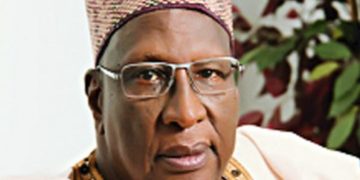
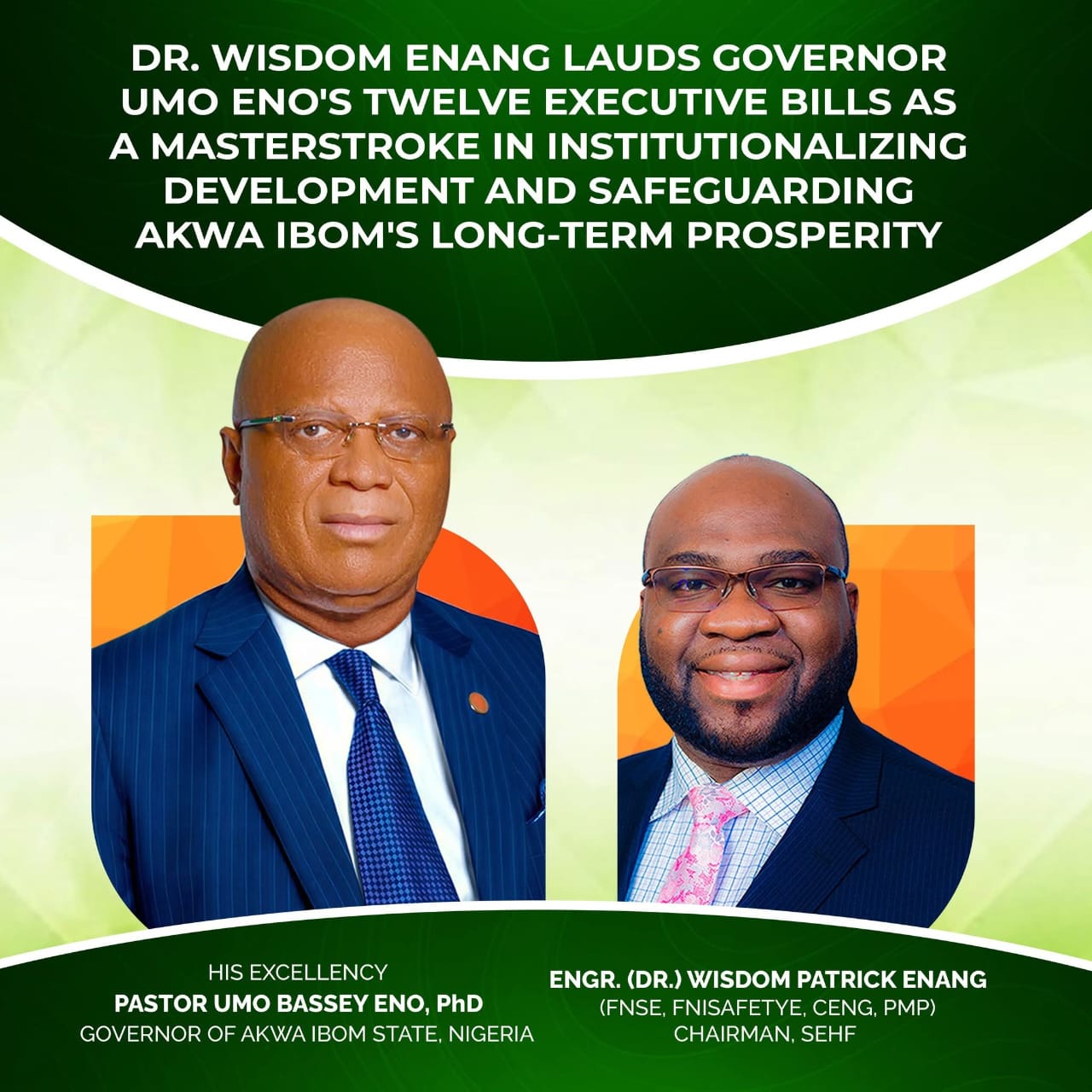
An internationally respected policy strategist and Adjunct Professor at the University of North Dakota, USA, Engr. (Dr.) Wisdom Patrick Enang, has described Governor Umo Eno’s transmission of twelve Executive Bills to the Akwa Ibom State House of Assembly as one of the most consequential exercises in institutional statecraft undertaken by any sub-national government in contemporary Nigeria, noting that the proposed legislative package represents a deliberate effort to codify development, entrench governance continuity, and construct enduring institutions capable of sustaining prosperity beyond political tenures.
Speaking with journalists in Uyo, the Akwa Ibom State capital on Friday, June 5, Dr. Enang, a globally respected energy expert observed that the defining distinction between temporary progress and enduring transformation lies in the extent to which development is institutionalized. According to him, while physical infrastructure often provides the most visible evidence of governance activity, the true sophistication of leadership is measured by its ability to establish institutions capable of preserving policy coherence, sustaining economic productivity, and protecting developmental gains across generations.
“Development reaches maturity when progress is no longer dependent upon the goodwill of leaders but secured by the strength of institutions.”
The erudite scholar noted that the world’s most successful development stories, from Singapore and South Korea to Rwanda, Botswana, and the United Arab Emirates, were not built merely through public expenditure or charismatic leadership. Rather, they emerged through disciplined investments in institutional capacity, regulatory quality, governance discipline, administrative continuity, and long-term strategic planning.
“Infrastructure may accelerate development, but institutions perpetuate it. The most valuable asset any government can leave behind is not a project. It is a system.”
According to the renowned Fellow of both the Nigerian Society of Engineers (FNSE) and the Nigerian Institution of Safety Engineers (FNISafetyE), the twelve Executive Bills collectively reveal a governance philosophy increasingly transitioning from project delivery to institutional consolidation. He observed that the proposed legislations span virtually every critical pillar of modern statecraft, including fiscal governance, healthcare resilience, social protection, justice administration, revenue modernization, digital land governance, tourism competitiveness, procurement transparency, emergency response systems, skills development, public accountability, and regulated enterprise growth.
“What Governor Umo Eno has placed before the legislature is not merely a collection of bills. It is an integrated governance architecture.”
Dr. Enang further argued that the true significance of the legislative package becomes evident when the bills are examined collectively rather than individually. In his assessment, each proposed institution performs a distinct governance function, yet together they form a mutually reinforcing ecosystem designed to strengthen administrative efficiency, deepen social inclusion, improve service delivery outcomes, expand economic participation, enhance investor confidence, and reinforce the structural foundations of long-term prosperity.
“The sophistication of governance is measured not by the number of reforms introduced, but by the degree to which those reforms reinforce one another to create durable developmental momentum.”
Commencing his analysis with the Akwa Ibom State Betting and Lottery Regulatory Agency Bill, the systems-driven governance strategist observed that the global gaming industry has evolved into a multi-hundred-billion-dollar economic sector whose sustainability depends largely on the quality of regulatory oversight governing its operations. Drawing comparative insights from the United Kingdom Gambling Commission, the Malta Gaming Authority, and South Africa’s regulated betting framework, he noted that jurisdictions which successfully regulate gaming activities simultaneously protect consumers, eliminate fraudulent operators, promote responsible participation, and generate substantial revenue streams capable of supporting public-sector development priorities.
“Markets generate opportunity, but institutions generate order. Sustainable economic value emerges when growth is governed by rules, transparency, and accountability.”
Turning to the Akwa Ibom State Office of the Public Defender Bill, the globally respected economic egghead described the legislation as one of the strongest social justice interventions contained within the reform package. According to him, access to justice remains a foundational pillar of democratic governance and inclusive development. Referencing public defender systems operating across the United States, Canada, South Africa, and several European jurisdictions, he observed that legal accessibility significantly strengthens social trust, protects vulnerable populations, and reinforces confidence in public institutions.
“Justice loses its moral authority when affordability becomes a condition for access.”
The Ethical and Attitudinal Reorientation Czar further commended the Akwa Ibom Broadcasting Corporation Establishment Bill, describing strategic communication as an increasingly important component of modern governance. He noted that successful societies utilize public broadcasting institutions not merely as communication platforms, but as instruments for civic education, cultural preservation, investment promotion, public accountability, tourism branding, and social cohesion.
“Information is no longer merely a communication asset. It has become strategic infrastructure.”
Analyzing the Akwa Ibom State Internal Revenue Service Bill, Dr. Enang described internally generated revenue as the fiscal foundation upon which sustainable sub-national development must ultimately rest. He observed that empirical evidence from the World Bank, International Monetary Fund, and Organisation for Economic Co-operation and Development consistently demonstrates that jurisdictions capable of strengthening domestic revenue mobilization enjoy greater fiscal independence, improved development financing capacity, and enhanced resilience against external economic shocks.
“No economy achieves sustainable prosperity through dependency. Fiscal sovereignty begins with revenue efficiency.”
The globally acclaimed development economist further extolled the Emergency Medical Services and Ambulance System Agency Bill, describing emergency response infrastructure as one of the most economically intelligent investments.
“According to World Health Organization studies, timely emergency interventions significantly reduce mortality rates, strengthen healthcare outcomes, improve labour productivity, and reduce the long-term economic costs associated with preventable medical fatalities.”
“In emergency medicine, every minute possesses economic value, social value, and human value.”
The renowned public policy reform advocate equally described the Senior Citizens Agency Bill as evidence of an administration increasingly aligning governance with the realities of demographic transition and inclusive social protection. He noted that advanced economies including Japan, Germany, Sweden, and Canada have long recognized that senior citizens constitute an important repository of knowledge, experience, mentorship, and social capital deserving of structured institutional support.
“The moral sophistication of any society is ultimately revealed in how it treats those who once built it.”
On the Hotels and Tourism Development Commission Bill, the Akwa Ibom-born, British-trained Chartered Engineer noted that tourism has become one of the world’s most powerful instruments for employment generation, foreign exchange earnings, enterprise development, and economic diversification. He observed that globally successful tourism destinations such as Dubai, Singapore, Mauritius, Rwanda, and Morocco achieved their competitiveness through deliberate institutional frameworks responsible for destination development, standards regulation, investment promotion, and sector coordination.
“Tourism succeeds where vision is supported by institutions and attractions are transformed into economic ecosystems.”
Dr. Enang further described the Fiscal Responsibility Board Bill as one of the most strategically significant governance reforms contained within the legislative package. According to him, international development literature consistently identifies fiscal discipline as a critical determinant of investor confidence, macroeconomic stability, public trust, and sustainable development performance.
“Strong economies are not defined by how much they spend. They are defined by how responsibly they manage what they spend.”
The widely respected governance analyst equally extolled the Dakkada Skills Acquisition Centre Bill, describing human capital development as the most reliable source of long-term competitiveness in modern economies. Referencing studies by the International Labour Organization, UNESCO, and the OECD, he noted that skills development significantly enhances productivity, entrepreneurship, employability, innovation, and social mobility.
“The future belongs neither to the richest economies nor the most resource-endowed economies. It belongs to the most skilled economies.”
Turning to the Akwa Ibom Geographic Information Services Bill, Dr. Enang observed that efficient land governance remains one of the most important enablers of investment attraction, urban planning, infrastructure development, and economic modernization. He noted that countries such as Rwanda, Singapore, Estonia, and the Netherlands achieved significant improvements in economic efficiency following the modernization and digitalization of their land administration systems.
“Land acquires its highest economic value when ownership is governed by certainty, transparency, and efficiency.”
The multiple excellence award winner further described the Public Procurement Regulatory Agency Bill as potentially one of the most transformative accountability reforms within the entire legislative package. According to him, procurement systems determine whether public expenditure ultimately translates into developmental value.
“Comparative evidence from South Korea, Chile, Estonia, and the United Kingdom demonstrates that procurement reforms substantially reduce leakages, improve project quality, enhance transparency, and strengthen public confidence in government spending.”
“Public procurement is where policy intentions become financial decisions. When procurement systems improve, development outcomes improve.”
Concluding his review of the individual legislations, Dr. Enang commended the Hospital Management Board Amendment Bill, describing healthcare governance as an evolving discipline requiring continuous modernization. He observed that effective hospital administration directly influences service delivery quality, patient outcomes, workforce productivity, operational efficiency, and public trust in healthcare institutions.
“Hospitals do not become effective because they possess buildings. They become effective because management systems function effectively.”
Situating the twelve bills within the broader framework of the ARISE Agenda, the Youth Development Advocate argued that the most profound significance of the legislative package lies in its collective capacity to institutionalize development gains beyond electoral cycles and individual administrations.
“Vision initiates transformation, but institutions sustain transformation.”
“History ultimately remembers leaders not only for the projects they build, but for the systems they leave behind.”
In his concluding remarks, Dr. Enang described the legislative package as one of the most comprehensive institutional governance reform frameworks ever proposed in Akwa Ibom State, stressing that its successful passage and implementation would significantly strengthen the state’s competitiveness, fiscal sustainability, social inclusion, healthcare resilience, investment attractiveness, and long-term economic trajectory.
“These twelve Executive Bills represent far more than legislation. They represent the codification of prosperity, the institutionalization of accountability, and the deliberate construction of a governance architecture capable of serving Akwa Ibom State for generations.”
He expressed firm confidence that with legislative support, disciplined implementation, and sustained policy continuity, the proposed reforms would substantially deepen the structural foundations upon which the future prosperity, competitiveness, and developmental ascendancy of Akwa Ibom State will increasingly rest.