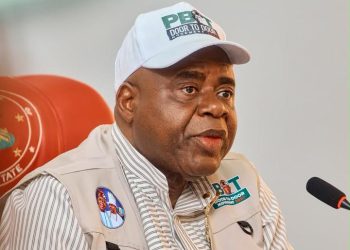






































In a political climate often dominated by personal ambition, the national leadership of the All Progressives Congress is drawing attention to a different, more strategic path. Through his representative, National Chairman Nentawe Yilwatda has effectively endorsed Dr Bala Maijama’a Wunti’s party-first philosophy — an approach increasingly seen as an innovative blueprint for electoral success and political stability ahead of 2027.
According to a statement signed by the Chief Communications Officer of Bala Wunti Support Organisation (BWSO), Abubakar Al-Sadique, the endorsement comes on the heels of Wunti’s donation of 24 buses to APC structures in Bauchi State — an initiative designed to strengthen grassroots mobilisation. While the gesture itself is significant, it is the thinking behind it that has resonated most with the party’s national leadership.
Described as both “timely and strategic,” the intervention reflects a deeper understanding of politics as a collective enterprise. Rather than channelling resources into personal political machinery, Wunti directed them toward party infrastructure — reinforcing systems that benefit all stakeholders.
For the APC chairman, this is more than commendable; it is exemplary. It signals a model of engagement where loyalty is expressed through tangible investment in party strength, and where ambition is pursued within — not outside — the framework of institutional growth.
This philosophy stands in sharp contrast to a broader political culture often characterised by fragmentation and personality-driven competition. Wunti’s approach suggests that enduring influence is not built on individual prominence alone, but on the ability to strengthen the structures that sustain democratic participation.
His consistent respect for party processes further reinforces this image. In moments that might tempt others to assert dominance, Wunti has demonstrated restraint and discipline, aligning with collective decisions and prioritising unity. This has positioned him as a stabilising figure within the party — one whose actions reduce friction and build cohesion.
His open support for Bola Ahmed Tinubu and the Renewed Hope Agenda also reflects this alignment. By anchoring his political activities within the broader vision of the party, he underscores a key principle: that leadership is most effective when it advances shared goals rather than personal narratives.
The APC leadership’s endorsement of this approach carries broader implications. It sets a standard for political conduct within the party, encouraging aspirants and stakeholders to see party development not as a secondary concern, but as the foundation of their own success.
At the grassroots level, the impact is already visible. Improved mobility and coordination enhance the party’s ability to connect with citizens, respond to local needs, and build a more resilient support base. But beyond logistics, the initiative reinforces a culture of collective responsibility — one where every contribution strengthens the whole.
Wunti’s model also integrates political strategy with social impact. His humanitarian interventions and youth-focused initiatives, while independently valuable, are aligned with party objectives, creating a seamless connection between governance, outreach, and political organisation.
By highlighting and endorsing this model, the APC chairman is effectively charting a course for the party’s future — one rooted in unity, discipline, and institutional strength. It is a subtle but clear call for a shift in mindset among party members, particularly those seeking office.
As the 2027 elections approach, the significance of this endorsement will likely grow. It offers not just a commendation of one individual’s actions, but a framework for how politics within the party can be practiced more effectively.
If widely adopted by office-seeking party members, Wunti’s approach may well prove to be more than a strategy—it could become the guiding philosophy that leads the APC toward its long-sought electoral and governance aspirations. In that sense, his model stands as a potential pathway to the party’s proverbial Promised Land—where unity, structure, and shared purpose translate into lasting political success.